Western Blot for Large Proteins: Complete Guide
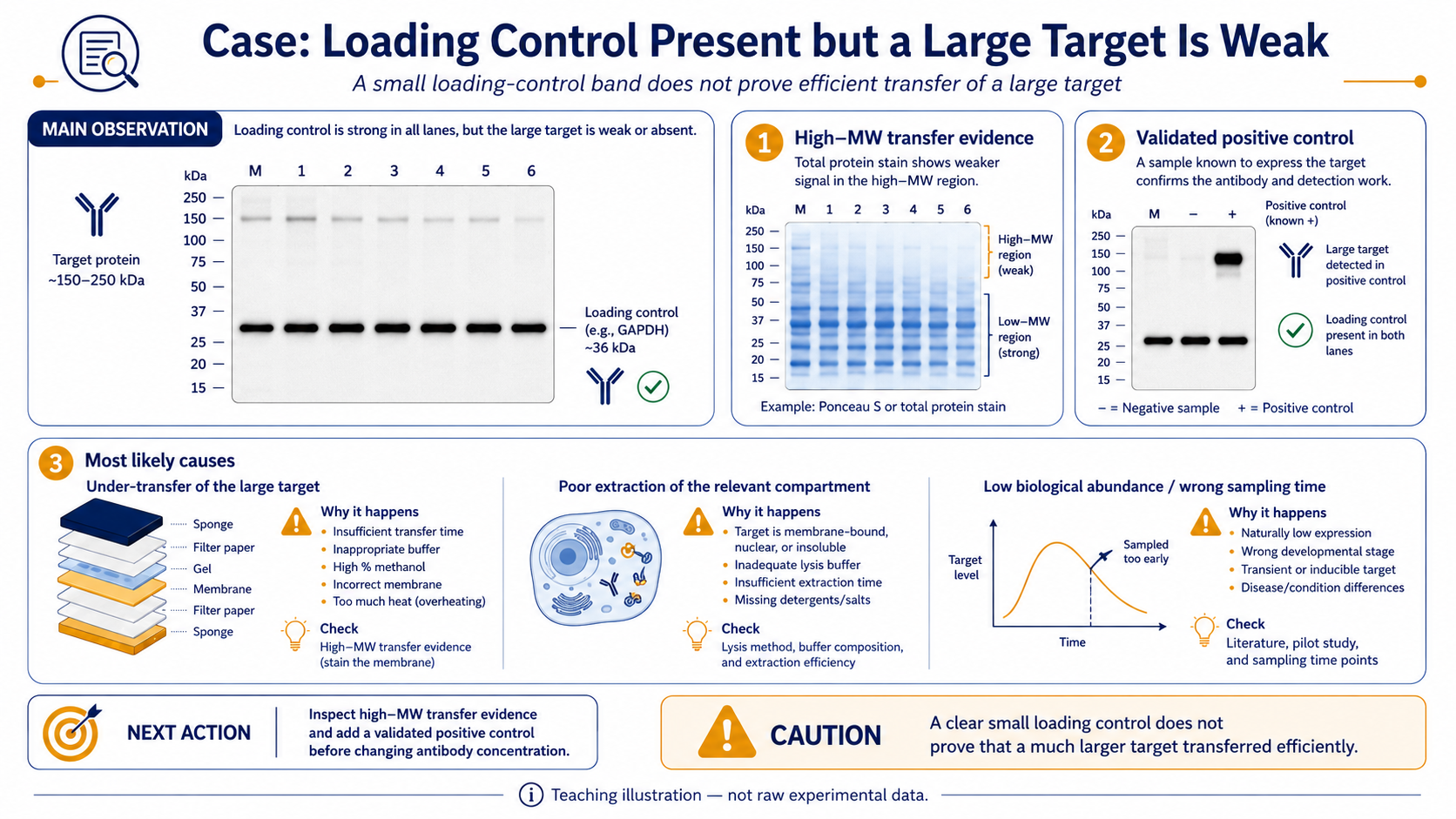
Detecting large proteins (>100-150 kDa) in western blot presents unique challenges. Large proteins transfer slowly, require extended transfer times, and may need special gel conditions. This comprehensive guide provides optimized protocols for detecting large proteins, including gel selection, transfer optimization, buffer composition, and methods to ensure complete transfer of high molecular weight proteins.
Overview
Large proteins commonly detected in western blot include:
- Structural proteins: 200-500 kDa (titin, nebulin, dystrophin)
- Enzymes: 100-300 kDa (DNA polymerase, RNA polymerase)
- Receptors: 100-200 kDa (growth factor receptors, cytokine receptors)
- Transcription factors: 100-200 kDa (some large transcription factors)
- Motor proteins: 200-500 kDa (myosin, kinesin)
Key challenges in large protein detection:
- Large proteins transfer slowly from gel to membrane
- Require extended transfer times (90-120 minutes or overnight)
- May require lower gel percentage (6-8%)
- Can be difficult to denature completely
- May aggregate during sample preparation
- Transfer efficiency decreases with increasing size
Proper gel selection, extended transfer times, and optimized buffer conditions are essential for successful large protein detection.
Key Challenges
Slow Transfer
Large proteins move slowly through the gel and transfer slowly to the membrane. Standard transfer times (60-90 minutes) are often insufficient for complete transfer of large proteins.
Solution: Extend transfer time to 90-120 minutes or use overnight transfer at lower voltage.
Incomplete Denaturation
Large proteins may not denature completely in standard sample buffer, leading to poor migration in gel and incomplete transfer.
Solution: Ensure complete denaturation, use appropriate sample buffer, and heat samples properly.
Gel Pore Size
Standard 10-12% gels may be too restrictive for very large proteins, preventing proper migration and resolution.
Solution: Use lower percentage gels (6-8%) for very large proteins (>200 kDa).
Gel Optimization for Large Proteins
Gel Percentage Selection
- 6-8% gel: For very large proteins (>200 kDa)
- 8-10% gel: For large proteins (100-200 kDa)
- 10% gel: For proteins around 100 kDa
- Lower percentage gels allow better migration of large proteins
- Consider gradient gels (4-12%) for wide molecular weight range
Electrophoresis Conditions
- Use standard voltage (100-120V) for lower percentage gels
- Run gels until dye front reaches bottom
- Large proteins migrate slowly - ensure adequate run time
- Use appropriate molecular weight markers for large proteins
Transfer Optimization
Extended Transfer Time
- Wet transfer: 90-120 minutes at 100V, or overnight at 30V
- Semi-dry transfer: May not be suitable for very large proteins
- Monitor transfer with pre-stained markers
- Verify complete transfer by staining gel after transfer
Transfer Buffer Optimization
- Include 0.01% SDS in transfer buffer to improve large protein transfer
- Maintain proper pH (8.3-8.5)
- Use 10-20% methanol for PVDF membranes
- Keep transfer buffer cool (4°C or ice pack)
Buffer Optimization
Sample Buffer
- Ensure complete denaturation (heat at 95°C for 5-10 minutes)
- Include reducing agents (DTT or β-mercaptoethanol)
- Use appropriate sample buffer volume
- May need to extend heating time for very large proteins
Transfer Buffer with SDS
Transfer Buffer for Large Proteins:
- 25 mM Tris base
- 192 mM glycine
- 10-20% methanol (for PVDF)
- 0.01% SDS (critical for large proteins)
- pH should be 8.3-8.5
Complete Optimized Protocol
- Prepare 6-8% SDS-PAGE gel (or gradient gel 4-12%)
- Load 20-50 μg protein per lane
- Ensure complete denaturation (heat at 95°C for 5-10 minutes)
- Run gel at 100-120V until dye front reaches bottom
- Prepare transfer buffer with 0.01% SDS
- Transfer at 100V for 90-120 minutes (wet transfer) or 30V overnight
- Keep transfer buffer cool (4°C or ice pack)
- Monitor transfer with pre-stained markers
- Verify complete transfer by staining gel
- Proceed with standard blocking and antibody incubation
Troubleshooting
Incomplete Transfer
- Extend transfer time (90-120 minutes or overnight)
- Add 0.01% SDS to transfer buffer
- Use lower gel percentage (6-8%)
- Verify transfer by staining gel after transfer
- Check transfer buffer pH and composition
Poor Migration in Gel
- Use lower percentage gel (6-8%)
- Ensure complete denaturation
- Extend heating time in sample buffer
- Check sample buffer composition