实验流程
Western Blot 完整流程:从样本制备到成像定量
本页适用于常规变性 Western Blot。具体参数仍应以所用抗体、凝胶、膜、转膜设备和成像系统说明书为准;通用条件只作为实验起点。
实验台手册 · 完整流程
培养细胞的 Western blot 完整流程
先选择直接 SDS 裂解或 RIPA 提取,再进行跑胶、湿转和 HRP 检测。制样步骤分别参考 CST 和 Thermo Scientific,转膜采用 Bio-Rad Mini Trans-Blot。根据样本选择一种裂解方法,并记录实际条件。
步骤旁的来源标记可跳转到本页末尾的厂商流程与说明书。
适用样本与设备
示例体系假设为培养哺乳动物细胞、Mini-PROTEAN TGX 胶(7.2 × 8.6 cm)、匹配的硝酸纤维素膜和 HRP 化学发光检测。Mini Trans-Blot 最大适配 7.5 × 10 cm 胶;这是槽体容量,不是 TGX 胶尺寸。更换样本、胶尺寸、膜或检测化学时,应重新核对对应说明书。
直接 SDS 裂解可把细胞制成含上样液的样本;RIPA 提取可得到适合兼容蛋白定量方法的可溶组分。记录所用缓冲液组成及加入的抑制剂。
下列条件来自厂商流程。用于样本比较前,先检查自己的样本回收、转膜和检测信号。
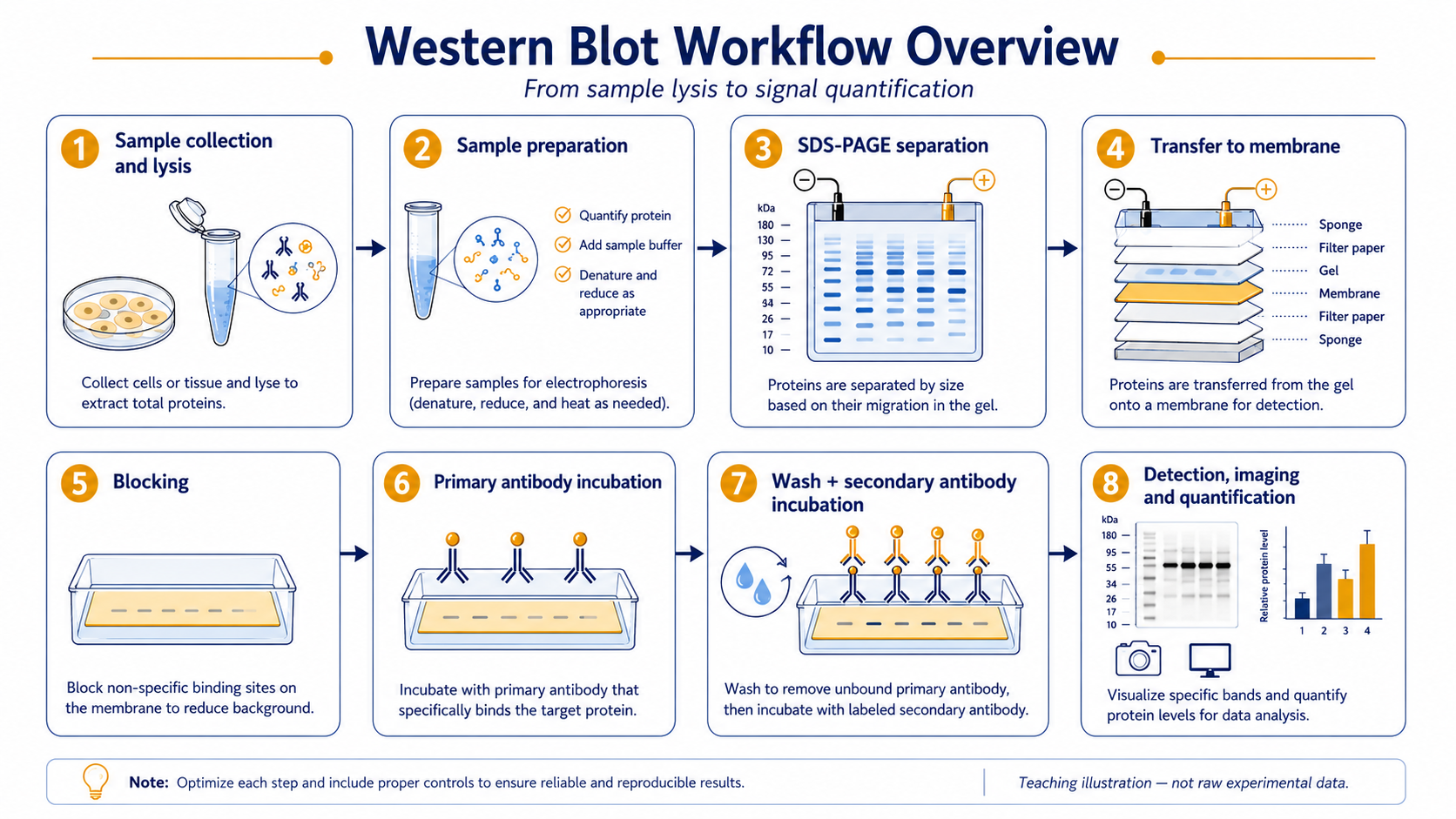
Western blot 八步流程总览
把制样、定量、跑胶、转膜、封闭、抗体孵育、成像和分析放在同一条流程中。下文的 RIPA 分支先定量;直接 SDS 分支保留已记录的制样与上样体积,不默认使用同一浓度测定。
示例体系所需材料
培养哺乳动物细胞[THERMO-89900]
RIPA 贴壁分支使用贴壁培养,悬浮分支使用清洗后的细胞沉淀;记录细胞系和收样状态。
CST 1× 还原 SDS sample buffer 分支[CST-WB]
CST #7722/#7723 配制:1 体积 3× SDS buffer 加 1/10 体积 30× DTT,再加水稀释为 1×。直接裂解起点为 6 孔板每孔 100 µL 或 10 cm 皿 500 µL。
Thermo Pierce RIPA 89900/89901 分支[THERMO-89900]
公开配方为 25 mM Tris-HCl pH 7.6、150 mM NaCl、1% NP-40、1% 脱氧胆酸钠和 0.1% SDS;产品本身不含蛋白酶或磷酸酶抑制剂。
BCA 兼容定量[THERMO-FAQ]
Thermo 列出 Pierce BCA 兼容;产品 FAQ 解释了 RIPA 对 A280 的干扰。
RIPA 后使用 2× Laemmli 和还原剂[BIORAD-GEL]
RIPA 定量后按凝胶体系配制 Laemmli 和还原剂,把还原剂计入最终体积。Bio-Rad 示例为 5 µL 样本 + 4.75 µL Laemmli + 0.25 µL β-巯基乙醇。
Mini-PROTEAN 胶和 Mini Trans-Blot 槽[BIORAD-MTB]
Bio-Rad 手册给出的最大 mini 胶尺寸为 7.5 × 10 cm,装冷却单元约需 950 mL 缓冲液。
0.2 µm 硝酸纤维素膜[CST-WB]
CST 的流程建议 0.2 µm NC;更换目标或膜材时要把改变写进记录。
一抗、二抗和 ECL[CST-WB]
一抗稀释遵循抗体产品页。CST #7074/#7076 示例为 HRP 二抗 1:2,000,指定 LumiGLO/SignalFire ECL 1 分钟;不能套到所有二抗或底物。
应写进实验记录的参数
窄屏可左右滚动查看完整参数表。
| 参数 | 起始条件 | 使用说明 |
|---|---|---|
| 直接 SDS 加热 | 95–100 °C 5 分钟;冰上冷却;微量离心 5 分钟[CST-WB] | 这是 CST 的直接 SDS 分支,不是 RIPA 澄清步骤。 |
| RIPA 贴壁比例 | 每 75 cm² 培养瓶、约 5 × 10⁶ HeLa 或 A431 细胞用 1 mL 冷 RIPA;冰上 5 分钟[THERMO-89900] | 该用量对应所列 HeLa/A431 培养条件;记录实际培养面积和估计细胞量。 |
| RIPA 澄清 | 约 14,000 × g 15 分钟;保留上清[THERMO-89900] | Thermo 流程把沉淀定义为细胞碎屑;目标回收不确定时应另存沉淀。 |
| 小型胶分离 | 4–15% TGX 约为 20–250 kD;200 V 恒压约 28–30 分钟[BIORAD-GEL] | 适用于 Mini-PROTEAN Tetra/TGX 体系;终点依据染料前沿,而不是统一计时。 |
| 转膜液 | 25 mM Tris pH 8.3、192 mM glycine、20% v/v methanol[BIORAD-MTB] | 这是 Bio-Rad buffer A 的明确起始配方;不要自行“校正”pH。 |
| Mini Trans-Blot 转膜 | 100 V 恒压 1 小时(表中参考电流 350 mA);或 30 V 恒压过夜(参考电流 90 mA)[BIORAD-MTB] | 使用冷却单元和搅拌子;缓冲液及胶条件会改变电流和热量。 |
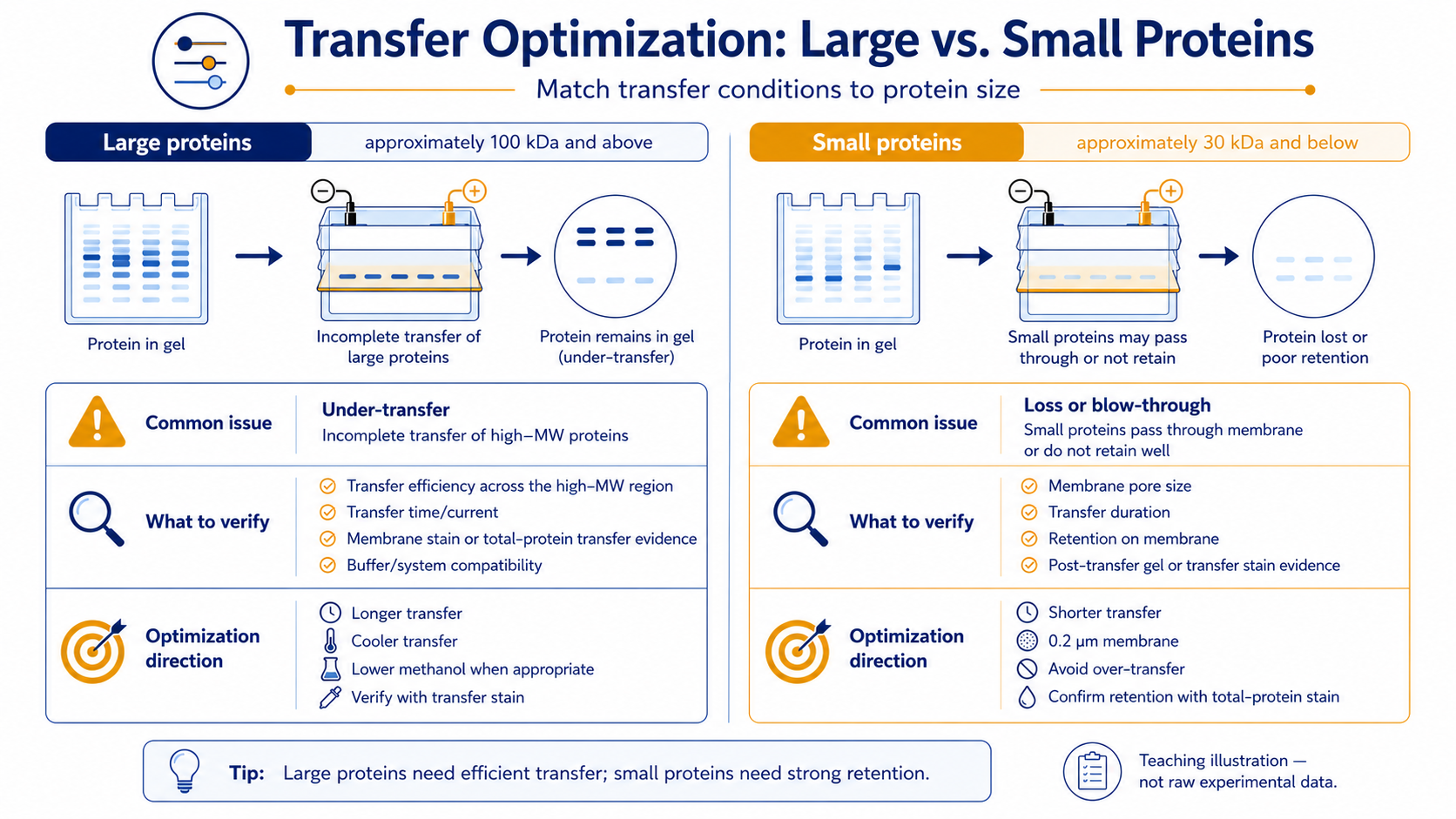
先区分大分子未转出与小分子保留不足
大分子可能仍留在胶内,小分子可能穿膜或在后续处理时丢失。结合转膜后胶、膜总蛋白染色和必要时的第二层捕获膜判断,再决定下一轮改变时间、膜孔径或缓冲液;图示不能替代上表的设备专用程序。
预计用时与检查要点
收样前
选择 SDS 或 RIPA,保留对照并绘制泳道图。
每份样本身份和组分保留计划明确。
第 1 天 · 制样
RIPA 贴壁分支为冰上 5 分钟加澄清 15 分钟,另计洗涤、操作和定量。
已定量可溶样本或已标记 SDS 样本。
第 1 天 · 跑胶与转膜
TGX 约 28–30 分钟;平衡 15–20 分钟;Mini Trans-Blot 一小时。
封闭前保存膜染色。
第 1 天 → 第 2 天
封闭 1 小时、洗膜、一抗 4 °C 过夜;次日洗膜、HRP 二抗 1 小时并检测。
原始曝光连同抗体/底物 ID 保存。
从制样到检测的操作步骤
选择一种制样方法,再按顺序跑胶、转膜和检测。每一步都检查样本或膜的状态,便于发现问题后回查。
1 · 先标记本次实验
在记录中写明细胞系、处理时间、收样状态、制样分支(CST SDS 或 Thermo RIPA)、胶浓度、膜孔径、转膜程序和抗体批号。
当场检查:样本标签和记录单能对应到每个泳道的裂解方法。
停止并处理:分支或样本身份不明确时停止;不要把 SDS 裂解物和 RIPA 裂解物混成“通用裂解液”。
2A · CST 直接 SDS 分支[CST-WB]
吸去培养基,1× PBS 清洗并吸尽;加入新鲜 1× SDS sample buffer(6 孔板每孔 100 µL,或 10 cm 皿 500 µL)。立即刮取,转管并冰上保存。超声 10–15 秒完成裂解并剪切 DNA。按 CST 分装分支取 20 µL,95–100 °C 加热 5 分钟、冰上冷却,再微量离心 5 分钟;原厂没有给出这一步的离心力,采用适合且有记录的实验室设置。
当场检查:样品应均匀、不再因基因组 DNA 明显拉丝。
2B · Thermo RIPA 贴壁分支[THERMO-89900]
去培养基,冷 PBS 清洗两次;按每 75 cm² 培养瓶含 5 × 10⁶ HeLa 或 A431 细胞加入 1 mL 冷 89900/89901 RIPA,轻晃铺匀,冰上 5 分钟。刮取、收集,约 14,000 × g 离心 15 分钟;转移上清。
当场检查:记录实际体积及抑制剂是否在使用前加入;上清和沉淀分开标记。
3 · 只对 RIPA 分支定量[THERMO-89900]
采用 Thermo 列出的去污剂兼容 BCA 流程。匹配含 RIPA 的标准和空白,记录浓度及稀释倍数。直接 SDS 分支保持 CST 规定体积并记录上样体积,不要假定同一测定适用。
当场检查:浓度、稀释倍数和最终上样量均写在泳道图旁。
4 · 完成 sample buffer 并跑 TGX 小型胶[BIORAD-GEL]
RIPA 定量后按凝胶体系的 Laemmli/还原剂配方处理,所有组分都计入最终体积。Bio-Rad 示例为 5 µL 样本 + 4.75 µL Laemmli + 0.25 µL β-巯基乙醇;90–95 °C 5 分钟或 70 °C 10 分钟。使用 1× Tris-glycine-SDS 跑胶液(25 mM Tris、192 mM glycine、0.1% SDS)。Tetra 的 4–15% TGX 胶可按 200 V 恒压约 28–30 分钟,到染料前沿到达底线时停止。CST 直接 SDS 样本已经是 1×,不要再加一整份上样液。
当场检查:上样体积不能超过实际孔容量,并记录蛋白质量。CST 的 20 µL 属于 10 × 10 cm 胶示例,不是 mini 胶通用量;目标区域应留在胶内。
5 · 平衡并组装湿转[BIORAD-MTB]
配制新鲜 Bio-Rad buffer A。胶、膜、滤纸和纤维垫在转膜液中平衡 15–20 分钟。按灰色夹板面 → 纤维垫 → 滤纸 → 胶 → 膜 → 滤纸 → 纤维垫顺序组装。用玻璃管或滚轮轻轻排气,锁紧夹板。
当场检查:常规 SDS 蛋白膜位于阳极/正极侧;目标泳道下没有气泡。
停止并处理:目标泳道有气泡或极性不确定时,应重新打开纠正后再通电。
6 · 转膜并控温[BIORAD-MTB]
装入 −20 °C 保存的蓝色冷却单元,加液至 blotting 刻度,放入搅拌子并全程搅拌。Bio-Rad 起始程序可选 100 V 恒压 1 小时,或 30 V 恒压过夜;表中 350/90 mA 是参考电流,不是同时设定的恒流程序。
当场检查:电流与所选缓冲液相符,槽体保持冷却;不要超过手册列出的电压。
7 · 封闭前检查膜[BIORAD-CHECK]
转膜后拍摄可逆总蛋白染色(如 Ponceau S)。预染 marker 只证明其中一些 marker 蛋白转移,不能证明所有目标都转移。结论确定前保留转膜后的胶;再按染色试剂说明去除染色。
当场检查:总蛋白图样方向正确,无局部空白。目标区空白时转膜仍未解决,不能直接证明抗体失败。
8 · 封闭和一抗孵育[CST-WB]
CST 使用 5% w/v 脱脂奶粉/TBST,室温封闭 1 小时,然后 TBST 洗 3 次、各 5 分钟。一抗 4 °C 过夜,按产品页选择 5% BSA 或奶粉/TBST。100 cm² 膜的原厂体积为封闭 25 mL、每次洗 15 mL、抗体液 10 mL。按膜面积缩放,并选择能覆盖整膜的容器。
当场检查:7.5 × 10 cm 膜为 75 cm²:数学缩放为封闭 18.75 mL、洗 11.25 mL、抗体 7.5 mL。这是计算体积,不是厂家单独验证的小型膜参数。
9 · 洗膜、HRP 二抗和检测[CST-WB]
一抗后 TBST 洗 3 次、各 5 分钟;按一抗宿主选择 HRP #7074 或 #7076,CST 示例 1:2,000、室温 1 小时,再洗 3 次。指定 LumiGLO #7003/SignalFire #6883 为 1 分钟;原文建议胶片先曝光 10 秒。实际底物和成像仪应遵循各自说明,并采集曝光梯度。
当场检查:二抗匹配一抗宿主;直接 HRP 标记一抗跳过二抗。计算比值前保存原图和未饱和曝光。
两种制样方法与后续步骤
图中分别列出 CST 直接 SDS 与 Thermo RIPA 制样,以及后续跑胶、转膜和检测步骤。具体用量见上方参数表。
计算示例
完整算例:准备一个 20 µL 教学泳道
假设 BCA 结果为 2.0 µg/µL,预实验选择 20 µg 泳道。这是教学计算,不是通用推荐质量。直接 SDS 分支若没有另行兼容的测定,不能直接套这个浓度计算。
20 µg ÷ 2.0 µg/µL = 10 µL RIPA 样本;加入 9.5 µL Laemmli sample buffer + 0.5 µL β-巯基乙醇 → 20 µL,为 Bio-Rad 示例配方的等比例放大。另加还原剂会改变名义原液比例,不把此配方称为独立精确的 1×。
若浓度只有 0.5 µg/µL,同一质量需 40 µL 样本,加液后 80 µL,可能超过孔容量。可浓缩样本、减少上样质量或选择更合适的孔;调整后记录实际质量和体积。
上机前与转膜后的检查
- 上机前:泳道图、目标表观分子量、制样分支、胶范围、膜孔径、转膜程序及抗体资料页均已写好。
- 通电前:胶和膜已平衡 15–20 分钟;夹层顺序和极性正确;气泡已排除;蓝色冷却单元已装入。
- 通电后:marker 和总蛋白图样在膜上;判断完成前保留转膜后的胶。
- 解释生物学结果前:图像未饱和,内参或总蛋白归一化方案已记录,原始图像已保存。
第一张结果应如何解读
Marker 不在膜上,转膜后胶仍保留目标区域[BIORAD-MTB]
解释
蛋白未从胶中转出,或夹层/电路失败。
下一步
核对极性、缓冲液新鲜度、胶平衡、气泡和电流;先重复转膜检查,不要先换抗体。
Marker 在膜上,但小分子目标消失[BIORAD-CHECK]
解释
目标可能穿过大孔径膜,或在洗涤中丢失。
下一步
尝试 0.2 µm NC 或 PVDF,并在主膜后放第二层捕获膜;降低转膜强度/时间并查看保留胶;不要直接判断“没有表达”。
高分子量目标留在胶中,小分子 marker 已转移[BIORAD-MTB]
解释
醇会使胶孔变紧,高分子 SDS 蛋白可能更难转出。
下一步
保持膜化学不变,再测试更长且低温的 Bio-Rad 转膜,或有记录地测试低醇/SDS 变体。
整张膜发黑但 marker 存在[CST-WB]
解释
部分 marker 蛋白已转移,但目标转膜仍需膜总蛋白染色检查。均匀背景可把下一轮比较指向封闭、抗体稀释、洗涤或曝光。
下一步
按抗体资料页调整,使用新鲜封闭/洗液并缩短曝光;本轮诊断保持转膜参数不变。
常见问题
能把 CST 的直接 SDS 分支叫作 RIPA 吗?[CST-WB]
不能。CST 示例直接用 1× SDS sample buffer;Thermo 89900/89901 是有公开配方、体积、抑制剂和澄清步骤的 RIPA。名称和泳道记录必须分开。
Thermo 89900 自带抑制剂吗?[THERMO-89900]
不带。Thermo 说明蛋白酶和磷酸酶抑制剂不包含在内;需要时在使用前立即加入兼容的抑制剂。
100 V/1 小时能复制到任何转膜槽吗?[BIORAD-MTB]
不能。这是 Bio-Rad Mini Trans-Blot 的设备、缓冲液、冷却和胶几何条件。其他槽体应使用自己的手册或验证程序。
转膜后可以马上丢胶吗?[BIORAD-MTB]
保留到膜总蛋白染色,以及必要时转膜后胶的残留检查,足以支持转膜判断为止。可见 marker 只是其自身蛋白的粗略检查,不能证明目标完整转移;保留胶有助区分转出不足和穿膜丢失。
厂商流程与说明书
文中标注的参考资料列在下方,可查阅原始用量和操作条件。
- CST-WB · Cell Signaling Technology — Western Blotting Protocol
B 节:直接 SDS 的体积、超声、加热和上样;A/C/D 节:0.2 µm NC、封闭/稀释液、100 cm² 膜面积对应体积,以及指定 HRP/ECL 条件。
- THERMO-89900 · Thermo Scientific — RIPA Lysis and Extraction Buffer (89900/89901), MAN0011565 Rev. B.0
第 1–2 页:配方、HeLa/A431 比例、贴壁冰上 5 分钟/悬浮 15 分钟、约 14,000 × g 15 分钟、可选沉淀超声及抑制剂加入时间。
- THERMO-FAQ · Thermo Scientific — RIPA 89900/89901 Product FAQs
89900/89901 产品 FAQ:RIPA 的强 A280 吸收、兼容比色测定和抑制剂时间。
- BIORAD-MTB · Bio-Rad — Mini Trans-Blot Electrophoretic Transfer Cell Instruction Manual, M1703930 Rev. K
印刷页 3、6–13:容量、平衡 15–20 分钟、夹层、冷却/搅拌及表 3.1;印刷页 15–20、22–26:尺寸、SDS/醇和膜相关排错。
- BIORAD-GEL · Bio-Rad — Mini-PROTEAN Precast Gels Instruction Manual and Application Guide
3.3–3.5 节(印刷页 9–10):sample buffer 配制、加热、1× 跑胶液、4–15% TGX 范围和 200 V 程序。第 10 章:膜总蛋白染色。
- BIORAD-CHECK · Bio-Rad Antibodies — Separating Proteins to a Blotting Membrane
Size of the Target Protein / Confirming the Transfer:膜位置、小分子第二层捕获膜、Ponceau S 可逆检查和 marker 的局限。
记录结果与相关指南
保存实验条件、原始图像和结果判断。下方提供记录单,以及制样、上样、转膜和定量的相关指南。